
 EN
EN

What Are the Components of a Vacuum Conveying System?
Vacuum Generator: The Power Source of Conveying System
Without a doubt, the most important part of a conveying system is the vacuum generator, and specifically, the piece that generates the force necessary for moving the material. It functions by converting mechanical energy into vacuum pressure, which allows a flow of material, whether it be a fine powder, granule, or small particle, to be moved. To be successful, a vacuum generator depends on the flow rate and the efficiency of the system with respect to the energy that the system utilizes. In the food and pharmaceutical processing industries, a vacuum generator is necessary to avoid of material, leaving build up of a bulk powder. In these industries, a vacuum generator is necessary to avoid. A vacuum generator at its best, achieves a flow and pressure for a system that spends less energy, and the more that is spent, the more productive. The more that is spent on a system, the more efficiency is present. The parameters above are some of the reasons why it is correct to say that a vacuum generator has some of the greatest processing energy.
Material Receiving Hopper: Oversight Every Hopper of Integrated Systems
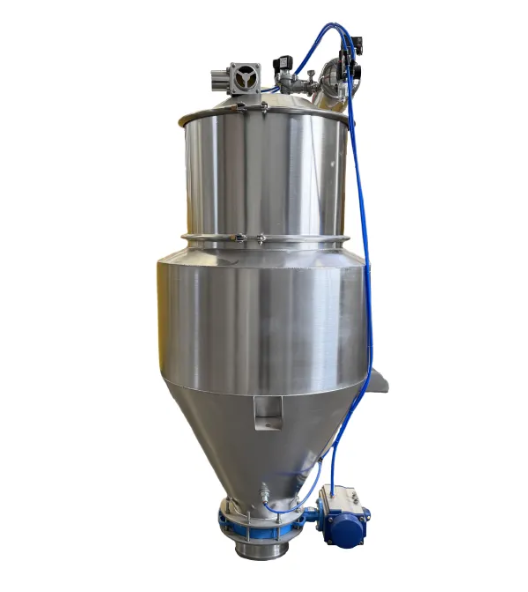
Once the Material Return System is done with its transport cycle, the Material Receiving Hopper activates its cycle to collect and unload a portion of material to be removed and stored. The design of the Hopper is pivoted to safely close deposits and release the material, even though hoppers tend to be the slowest parts of the material handling devices. The hoppers are built to last, with internally smooth flow surfaces and side slopes that are discharge flow biased to help empty the hoppers and are appropriately pitched to overcome the friction of the stored material. Controlled emptying systems integrated into the hoppers to discharge material flows are conveyor systems of waste-saving frustration free destinations of the work that was done to help build an efficient flow. Where the materials stored are food, cosmetics or similar, the design of the hoppers will be food grade or corrosion resistant to protect the materials of the stored products. Each closure and discharge of the hopper is a minor cycle of the integrated system, and the overall design of the systems, with attention to these details, establish the credibility of the systems to their customers and withstand professional scrutiny.
Conveying Pipes and Fittings: The Path for Material Transport.
Pipes and fittings form the network through which materials are conveyed from a source to a destination and the quality of these components affects the system's efficiency and durability. Pipes should be matched to the material they are transporting. Pipes that are too narrow run the risk of clogging. Pipes that are too wide will unnecessarily use more energy. The best pipes are those made from tough materials that are resistant to wear and tear for use with abrasive materials such as chemicals or minerals. Fittings such as bends and connectors are designed to improve material flow and reduce pressure drop. The right selection of fittings will yield a system that does not require frequent replacing of the components and will use energy more efficiently in turn making the system more cost effective. Moreover, Leak-proof connections are essential for maintaining the vacuum pressure with the system in order to avoid loss of product and other inefficiencies.
Filtration Systems: Equipment Protection
Filtration systems are one of the most crucial elements of vacuum conveying systems, especially those dealing with interactive and dusty materials. Filters are responsible for keeping all the particles in the air stream from entering the vacuum generator, which most likely causes damage to the vacuum generator. Filters are also responsible for ensuring that the air that is coming from the system is clean and meets the environmental requirements from the system. Therefore making the system legal and compliant to the industry. Filters that are the best, are the ones that keep the most dust and particles that are in the air. While balancing the airflow and dust and particles removed. Those are systems that keep up in a +70% efficiency and for systems like those in the pharmaceuticals, optoelectronics industries, and other industries where the cleanliness of the products that are created is required. More and more, advanced systems are complemented with a renew for growing systems. systems that prevent cross contamination from products. The Maintenance Systems, validation of these systems advanced with ease of designed advanced maintenance systems along with simplicity of the systems designed to promote the adopted lessens the protection complexity in systems provided in ease of compliance with the reduced maintenance protection the productivity more efficient.
Control Systems. Automated Precision for Peak Performance
Modern vacuum conveying systems use advanced control systems to manage the operations vacuum pressure control and material flow rates. Intelligent systems interface control unit with vacuum pressure, material flow, sensors, and PLCs to monitor and manage operations for optimal efficiency. For instance, clogging can be detected and control systems vent pressure, and alarms can be activated to save system time for expensive downtime. Operators can monitor, manage, and even control system functions and alarms with simple, user-friendly, and intuitive interfaces, often eliminating the need for specialized training. Smart control systems improve operational efficiency and allow the user to capture and analyze data for process enhancements. Automated systems reduce human operational errors and improve operational stability, process costing, and overall system efficiency, making the operational system a smart investment for most productive businesses.
Why the Best Parts Make a Difference
Choosing the best system parts costs less long-term and pays off faster. Although cheap parts don't seem like a large loss at the start, the added costs from replacing a broken part, downtime, and scheduled maintenance will always add more costs faster than quality parts. Quality parts last and minimize costs from downtime and maintenance. For example, production is not interrupted because there is not a need for a large amount of repairs from having a quality vacuum generator with non-wearing pipes. Whether the system uses an energy-efficient vacuum generator or a filter with less resistance, operational costs decrease from the efficiency of system components. dependable and quality parts. Quality parts speak for themselves because of the constant reliable and efficient output their systems provide, but more importantly they help businesses of all scales become more efficient. Consistent systems help businesses grow and improve customer satisfaction. Quality parts improve the product directly. Quality components improve all systems and systems containing reliable components perform better than their competitors.
Balancing Professionalism and Value in System Design
The best vacuum conveying systems have a good mix between technical professionalism and economic value. Specialization makes sure that systems sustain their efficiency, mitigate risks, and maximize throughput in challenging environments. Value is determined from a system’s design, energy usage, as well as excess avoidance. The best systems combine high-end components with smart design to yield systems that perform excellently at low costs. This is beneficial to businesses because systems fulfill their technical requirements as well as give businesses a good ROI. A well vacuum conveying system is a designed system that is professional, economically beneficial and for that reason makes a business for a well competitive market.


