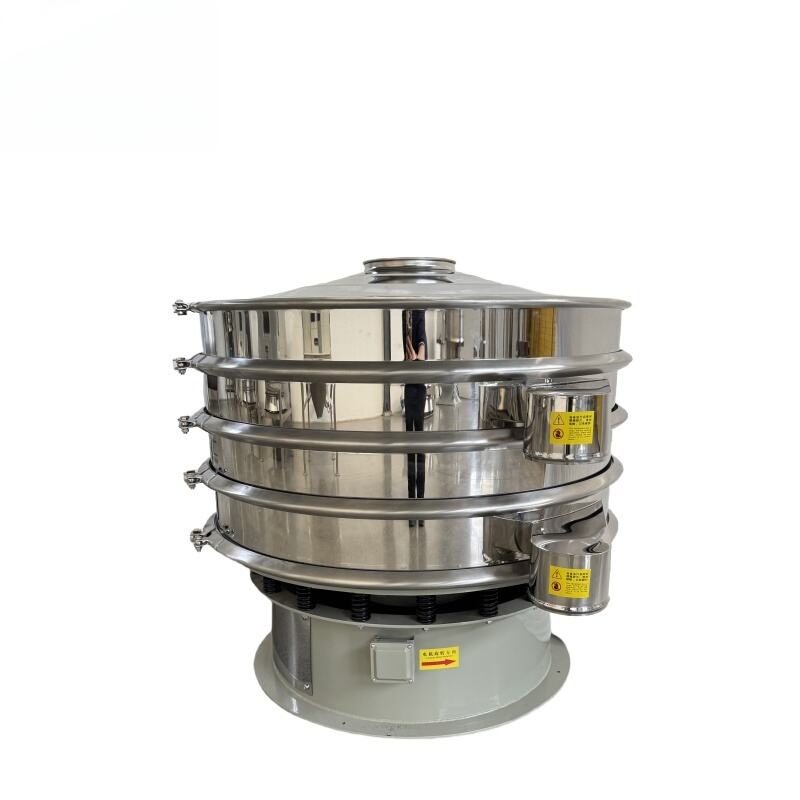
The Core Value of Vibrating Screen Manufacturers: The Invisible Pillars Driving Industrial Efficiency
In today's industrial system, where the precision of resource classification directly determines a company's profit margins, the value of professional vibrating screen manufacturers has long transcended mere equipment supply. At their core, they are strategic partners in industrial productivity upgrades, redefining production efficiency through three key dimensions:
1. Revolutionary Optimization of Total Cost of Ownership (TCO)
Mining operation data shows that the hidden costs caused by substandard screening equipment can reach 3-5 times the equipment purchase price. This is because each average failure repair requires the production line to shut down for 8-72 hours. Calculated at a processing capacity of 500 tons per hour, the loss from a single shutdown can reach 240,000 to 2.16 million USD. More critically, non-optimized vibrating motors can waste 15-30% of power, resulting in annual energy costs increasing by over 80,000 USD. Leading manufacturers have addressed this through modular structural design, reducing screen replacement time by 40%, combined with material innovations such as tungsten carbide-coated screens (with a lifespan of 5,000 hours), completely breaking through the maintenance bottleneck of traditional manganese steel screens requiring replacement after just 300 hours. For example, after a copper mining company introduced a customized high-frequency screen, the moisture content of the concentrate dropped sharply from 15% to 8%, saving $1.4 million in transportation costs annually, demonstrating how manufacturers' technological capabilities can fundamentally reshape TCO.
II. The Enabling Engine of Industrial Technological Generational Leap
Leading manufacturers are driving the evolution of vibrating screens from mechanical tools to intelligent sorting hubs. By integrating vibration spectrum monitoring systems, they achieve fault warnings four hours in advance, boosting production capacity utilization rates to over 95%. In precision control, the integration of AI visual feedback and air pressure compensation technology reduces grading errors from ±2mm in traditional equipment to ±0.3mm, enabling photovoltaic silicon material purity to break through the industry bottleneck of 99.99%. Pharmaceutical companies have also benefited: a fully sealed design compliant with FDA 21 CFR 11 standards has avoided the risk of failing GMP certification, which could have cost $2 million. These technological advancements fundamentally reshape the rules of industrial competitiveness—when the dynamic simulation amplitude technology of vibrating screens increases theoretical production capacity conversion rates from 75% to 93%, it means that energy consumption per ton of ore processed is reduced by 18-25%, directly creating product premium space.
III. Engineering Vehicles for Global Sustainable Strategies
Facing the EU Circular Economy Act's mandatory requirement of 70% material recovery rate by 2030, specialized manufacturing equipment has become the core of green transformation. In the new energy sector, ultrasonic vibrating screens achieve 98% recovery purity of lithium, cobalt, and nickel elements from discarded power batteries; in the aggregate industry, wind-cooled equipment reduces annual carbon dioxide emissions by 380 tons per unit (equivalent to the carbon sequestration capacity of 20,000 trees); and food factories have reduced raw material wastage rates from 5% to 0.2% using intelligent screening systems, saving 2,400 tons of wheat raw materials annually. These breakthroughs have elevated vibrating screen manufacturers to engineering partners in achieving carbon neutrality goals—as the再生资源 industry relies on them to achieve a 97% recycling rate for construction aggregates, the manufacturers' accumulated database of parameters for handling sticky and wet materials is becoming the technological foundation for the global implementation of the circular economy.

30
May
29
May
18
Jun
"Before installation, manual handling was killing our production speed and safety records. Since implementing this system, our line efficiency jumped by 40%. The ROI was clear within months – reduced labor costs and zero handling injuries in 18 months. Seamless integration with our packaging line was the cherry on top."

"We struggled with product damage during transfer for years. This gentle conveying solution eliminated breakage completely while meeting strict FDA sanitation standards. Maintenance is surprisingly simple, and downtime dropped by 70%. Worth every penny for quality-sensitive industries."

Copyright © Henan Zhongren Machinery Equipment Co., Ltd.
 EN
EN