
 EN
EN
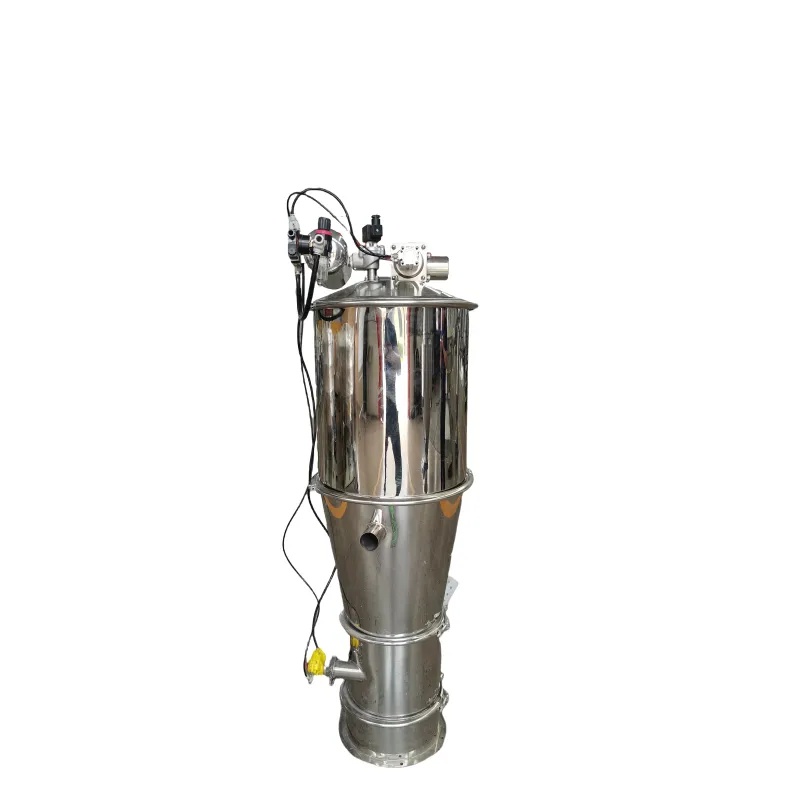
Vacuum feeding machines use a combination of air flow and pressure to allow the closed transport of powder and granular materials for easier use of aerodynamics and industrial automation. These machines are customized with different modes of transport for their adaptable versatility. For instance. There are dilute-phase and dense-phase modes designed for lower and higher fluidity of materials. These modes transport and handle materials such as starch, flour, and chemical/metallurgical powders. Proper adaptive/transports design ensures that materials are transported without loss of their original structure caused by clumping or breaking as well as without the risk of clogging the transport pipeline. Additionally, the core components of the machines are created from high-quality, wear, and corrosion-resistant materials, and the internal pipeline design is optimally created for consistent flow of transported materials. These features make vacuum feeding machines an essential solution for traditional transport equipment's material transport problems.
Real World Uses for Industrial Applications
Vacuum feeding in the food processing industry has fundamentally changed how soy milk powder, and flour products, are produced. one of the leading companies in soy milk powder processing completed the intelligent upgrading of one of its production lines with custom vacuum feeding and screening integration systems. With the introduction of the said systems, the need for manual intervention during the feeding of raw materials was eliminated and the daily processing capacity of the soy milk powder was increased by over 30% and the raw material loss was less than 0.5%. In flour milling, the vacuum feeding systems are engineered to control dust, and even explosion, problems associated with traditional conveying systems, thereby enhancing the overall safety and stability of the production process. These numerous practical applications clearly demonstrate the remarkable practicality and adaptability of vacuum feeding systems in the wide-ranging food processing industry.
The Compliance with Safety and Sanitation Design
When it comes to the safety of production and sanitation, the food, pharmaceutical, and chemical industries have strict vacuum feeding machine guidelines, which comply with the GMP guidelines of each of their respective industries. The equipment's closed transportation structure completely encloses materials and isolates them from the external environment to avoid cross-contamination and ensure the external environment's entry. Due to the high risk of dust, the equipment has an advanced dust and high-efficiency filtration system, which captures over 99% of dust. This advanced dust and high-efficiency filtration system also meets environmental protection and dust emission standards of North America, Western Europe, and other areas. In addition, the closed transportation structure has an external environment easy to cleanse and disinfect, thus meeting the hygiene of food and pharmaceutical production.
Economic Benefits of Cost Reduction and Increased Efficiency
From the perspective of different economic gains, the use of vacuum feeding machines provides great benefits to businesses. In terms of labor costs, one unit of this type of equipment can do the work of 3 to 5 people who do manual labor, so the equipment can reduce the annual work costs of businesses. In operating costs, the equipment is designed with energy-saving air pumps, so it will consume about 25% less energy than competing mechanical conveying equipment. Additionally, the closed transport system reduces the loss of transport materials, so the savings will accumulate. As for maintenance costs, the equipment is modular and designed with less breakable parts, so less maintenance is required. The main components of the equipment can operate for extensive periods of time without the need to change them, and all this contributes to the reduction of maintenance and operational costs for businesses.
Global Technical Adaptation and Upgrading
As the global manufacturing industry continues to evolve, the vacuum feeding machine's target markets are becoming easier to distinguish. For North America and Western Europe, the focus of the markets lies in the safety compliance and the machine’s ease of use regarding intelligent control and operation. Conversely, the Asia-Pacific region emphasizes the machine’s operational efficiency and cost-effectiveness regarding high-volume mass production. The newest vacuum feeding machines having modular designs allows for the personalization of the machine’s modular components based on regional and customer-specific demands. For example, customization to add intelligent monitoring modules for customers in Europe and North America allows for real-time tracking of the conveying process. For customers in the Asia-Pacific region, the focus of customization is to optimize conveying efficiency for large-volume production. Ongoing research and development in high-tech core components are enabling an expanding range of applications for the equipment. The use of industrial material conveyance is now growing beyond the traditional food and chemical industries and into the fields of new energy, ceramics, and construction materials.